How long should a resume be? An honest answer
One page or two? The real rule by experience level, what to cut when you're over, and why the right length changes with every job you apply to.
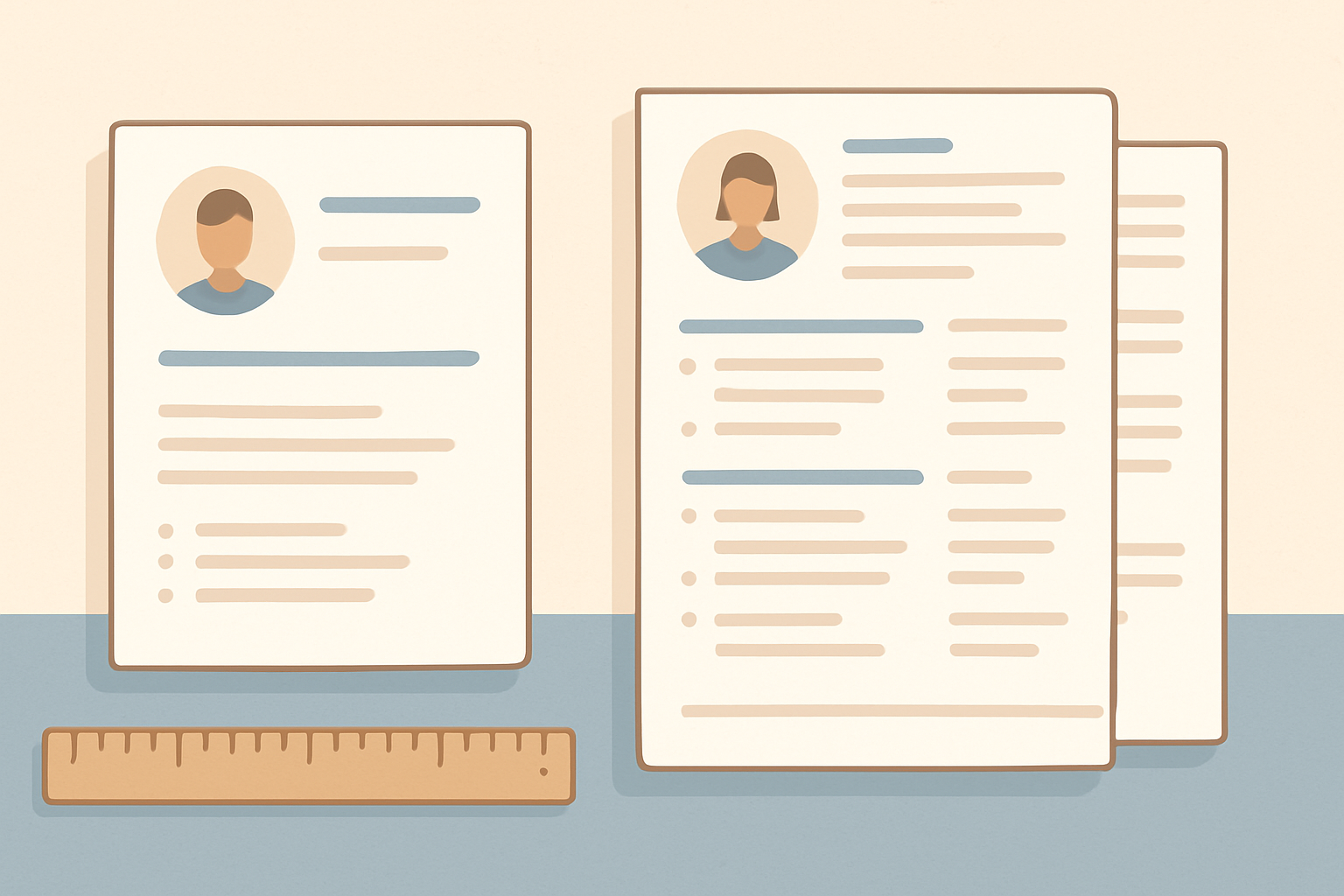
Ask five people how long a resume should be and you'll get five confident, contradictory answers. One page, always. Two pages if you're senior. "Length doesn't matter anymore because of ATS." Someone's uncle who hired people in 1997 will insist on one page or the trash.
Here's the answer I give when friends ask, after years of watching what actually gets callbacks: one page for roughly the first six years of your career, two pages after that, and almost never three. But the interesting part isn't the rule. It's knowing when to break it, and what to cut when you're over.
The short version, by experience level
If you have under 2 years of experience, use one page. No exceptions I can think of. A two-page resume from a recent grad reads as padding, and recruiters can smell padding from the subject line.
Between 2 and 6 years, one page is still the default. You might stretch to two if you've had genuinely distinct roles (say, three years as a nurse and three as a clinical informatics analyst) and both matter for the job.
Past 6 or 7 years, two pages is normal and expected. Cramming 12 years into one page usually means shrinking the font to 9pt and deleting the results that would have gotten you the interview. Don't do that.
Three pages is reserved for a few specific cases: academic CVs (publications and grants belong there), federal government applications (USAJOBS practically demands length), and some senior technical or executive roles where a portfolio of projects genuinely needs the room. If none of those describe you, three pages is telling the reader you can't prioritize. That's a bad first impression for any job that involves prioritizing.
Why recruiters actually care about length
It's not about attention spans, or not only. A recruiter screening 200 applications gives each resume a first pass of about six to eight seconds. In that pass they're looking for maybe four things: current title, current company, years of relevant experience, and one or two skills from the posting.
A tight one-page resume makes those four things impossible to miss. A bloated two-pager buries them under a "Professional Summary" paragraph, a skills cloud with 30 entries, and bullets about jobs from 2011.
Length is a proxy for judgment. When a hiring manager sees a two-page resume from a candidate with three years of experience, the actual thought isn't "too long." It's "this person doesn't know what matters." Which is a worse thing to communicate than any individual weak bullet.
There's a flip side, and it's less discussed: a suspiciously short resume from a senior candidate raises questions too. If you've been a director for a decade and your resume is half a page, I start wondering what you're hiding. Length should match the story.
What actually earns space on the page
Here's the test I'd apply to every line: does this help THIS employer decide to call you? Not "is it true," not "am I proud of it." Does it move this specific decision.
Things that earn their space:
Your last two roles, in detail. Four to six bullets each, results first, numbers wherever you have them. This is 60% of your resume's value.
Skills the posting explicitly asks for. If they say Salesforce and you have Salesforce, that word needs to be on page one, ideally in a bullet showing what you did with it.
Anything that answers a predictable objection. Career gap? A one-line consulting or caregiving entry beats an unexplained hole. Switching industries? A bullet that translates your old work into their vocabulary.
Things that don't earn space, ever:
"References available upon request." Everyone knows. This line has cost thousands of people their last bullet point.
Your full address. City and state, done. Nobody mails you anything.
An objective statement. "Seeking a challenging position where I can grow" says nothing. If you want a top section, write a two-sentence summary with your title, years, specialty, and one big result.
Jobs older than 10 to 12 years, in detail. A senior candidate's 2009 role gets one line or gets cut. The recruiter is not reading it, and the ATS doesn't reward it.
High school. If you have a college degree or five years of work, high school is gone.
The one-page squeeze: what to cut first
Say you're at a page and a quarter and need to get to one. Cut in this order:
First, old bullets. Your role from six years ago doesn't need five bullets. It needs two, and they should be the two with numbers in them.
Second, duplicate skills. If three bullets all prove you can manage projects, keep the one with the biggest result and fold the others.
Third, the skills section itself. Most people list 20+ skills; the ATS and the human each care about maybe 6. Keep the ones in the posting, cut the ones every applicant claims (Microsoft Office, "communication").
Fourth, formatting waste. A three-line header with your name in 22pt, horizontal rules everywhere, one-inch margins on all sides. You can recover four or five lines with tighter spacing before touching a single word. Just don't go below 10.5pt font or recruiters over 40 will silently hate you.
What you should not cut: numbers, results, or the specific keywords from the job description. Those are the whole game. A shorter resume that dropped its evidence is worse than a slightly long one that kept it.
The part nobody wants to hear: the right length changes per application
This is where the one-page versus two-page debate misses the point. The real question isn't how long your resume should be. It's which parts of your experience this specific job needs to see.
Applying to a management role? Your people-leadership bullets move up and expand, your hands-on technical bullets shrink. Same career, different resume. Applying to a startup? The bullet about thriving in ambiguity at a 20-person company beats the one about navigating enterprise process, even though both are true.
Doing this honestly means every application gets a slightly different resume, and yes, that's tedious. Most people write one resume, feel the tedium, and send the same document to 40 jobs. That's precisely why tailored applications stand out: almost nobody does it. If you want the result without the hour per application, JobTailor does the reshuffling for you. It reads the job posting, picks which of your experience matters most for that role, and builds the tailored version, which usually solves the length problem as a side effect, because the irrelevant stuff simply doesn't make the cut.
Common length questions, answered fast
Does the ATS care how long my resume is? No. ATS software parses one page or three the same way. Length matters to the human who reads it after. Anyone telling you "ATS rejects two-page resumes" is repeating a myth.
Should I use smaller fonts or margins to fit one page? Down to a point. 10.5pt font and 0.6 inch margins are fine. 9pt font and 0.4 inch margins mean you should be cutting content instead, or accepting that you're a two-page candidate now. That's not a failure. It's seniority.
Is a two-page resume okay if page two is only a third full? It looks unfinished. Either cut back to one tight page or expand your recent roles until page two is at least half full. A trailing wisp of orphaned content on page two is the worst of both options.
What about a CV versus a resume? Different documents. A CV (academia, medicine, research, and standard in much of Europe) is comprehensive by design and grows with your career. Everything in this article is about resumes, the marketing document, where shorter and sharper wins.
Do cover letters count toward length? No, and a good one buys you slack. If there's context that doesn't fit the resume (a relocation, a career pivot, a gap), the cover letter is where it goes. Don't burden the resume with narrative.
A quick reality check you can run tonight
Print your resume, or just look at it on screen, and give yourself seven seconds. Then look away and ask: what's this person's current title, how many years have they done this, and what's their single best result?
If you can't answer all three from your own seven-second scan, length isn't your problem. Signal is. Fix that first: move your best material into the top third of page one, lead every role with its biggest number, cut everything that made you hesitate.
Then, if you're still over a page with under seven years of experience, cut old bullets until you're not.
And if the whole exercise leaves you staring at 15 versions of your resume in a folder named "resume_final_v2_ACTUAL," there's an easier way to live. Upload your resume to JobTailor free, paste in a posting, and see what a version tailored to that job looks like. Worst case, you'll spot what your current version buries. Best case, you stop having the length debate entirely, because a resume built for one specific job tends to end up exactly as long as it needs to be.